
Search Has Changed. But SEO Has Not Disappeared
Imagine a typical situation.
A person wants to buy software for their business. Or find an accountant, a marketing agency, a lawyer, a contractor, a SaaS service.
In the past, they would open Google, enter a query, and browse several websites.
Today, they might start differently:
“Which CRM is best for a small B2B company with 20 employees?”
And instead of a list of ten links, they get a ready-made answer.
Then they ask:
“Which companies offer such solutions?”
Then:
“Which of them work with companies in the US and Canada?”
And further:
“Which have good reviews and real case studies?”
What we have now is not a single search query, but a conversation with search.
In this conversation, the user may see only a few companies.
And if your company doesn’t appear in the answer, the potential customer may never even learn of your existence.
This is where the concept of AI search optimization comes in.
But first, it’s important to understand what has actually changed—and what hasn’t.
What Is Happening with Google and Search
For twenty years, small businesses mainly needed a clear formula:
keywords → optimized page → links → Google rankings → traffic → customer.
This formula still works.
But now, a new layer has appeared on top of traditional search results.
Google is developing AI Overviews—AI-generated summaries that can appear directly in search results. At the same time, users are also using separate AI systems and AI search, including ChatGPT, Perplexity, and other services.
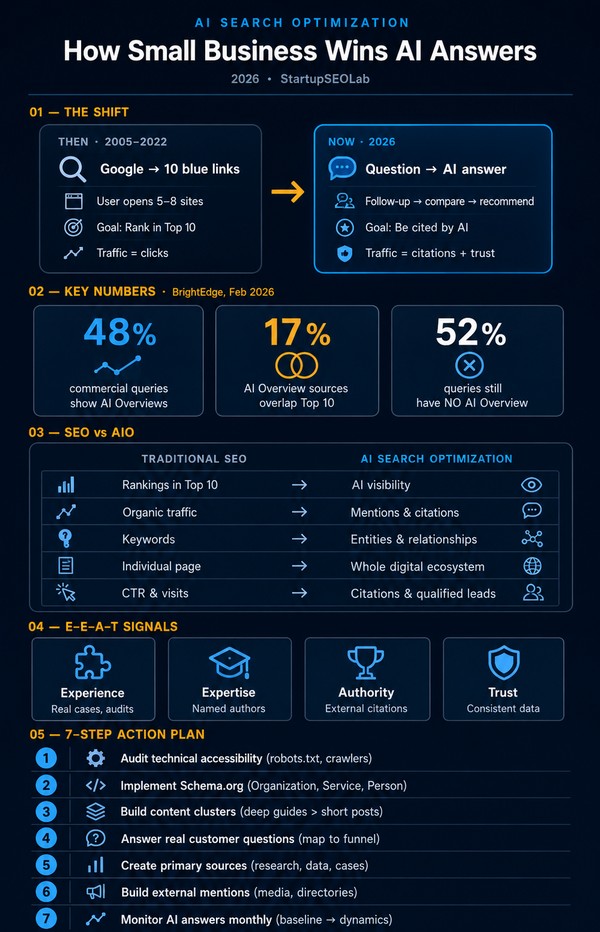
According to BrightEdge, in their sample of tracked queries, the presence of AI Overviews grew from approximately 30% to 48% over the year to February 2026. At the same time, about 52% of queries in the same sample still did not show AI Overviews. This means traditional search hasn’t disappeared—it’s just that businesses now have an additional way to be found.
There is another interesting metric.
BrightEdge found that only about 17% of sources cited in AI Overviews also rank in Google’s organic Top 10. In other words, a good position in Google and appearing in an AI answer are related but not identical tasks.
For a business, this means a simple thing:
It’s not enough to just rank well. You also need to make information about your company understandable to new search systems.
What Is AI Search Optimization in Simple Terms
AI search optimization (AIO) is the work on a company’s website, content, and digital presence so that AI-powered search systems can correctly:
understand what the company does;
identify its products and services;
connect the company with the right topics and categories;
find supporting information;
use this information in the answer to the user;
and, if necessary, cite the source.
To put it very simply:
Regular SEO asks:
“How can I get Google to show my page higher?”
AI search optimization asks:
“How can I make the search engine or AI understand who I am, what I do, and why information about me deserves trust?”
This doesn’t mean that keywords, links, technical SEO, or organic rankings are no longer important.
On the contrary.
Google directly states that AI features are part of Search, and the basic requirements for site accessibility and quality continue to matter.
AI search optimization is an additional layer on top of the SEO foundation, not a replacement for it.
A Few Terms You Will Encounter
Many names have emerged around the new search. For a business owner, this easily becomes confusing.
Let’s break them down without complex terminology.
AI SEO
A general name for SEO approaches related to AI-powered search.
LLM SEO
Optimizing information and content with consideration for how Large Language Models (LLMs) find, understand, and use information.
Generative Engine Optimization — GEO
GEO is commonly used to describe optimizing a company’s presence in generative responses.
That is, the goal is not just:
“To get into the list of results.”
But:
“To become one of the sources from which the answer is formed.”
Answer Engine Optimization — AEO
AEO focuses on direct answers to user questions.
For example:
What is AI search optimization?
Instead of a long introduction, the page immediately provides a clear definition.
AI visibility
This is no longer a method, but a result that can be tracked:
how often and in what context the brand appears in AI-generated answers.
All these areas overlap.
In this article, we use the broader term—AI search optimization.
AI Search Optimization vs. Traditional SEO
Let’s imagine two situations.
In the first, a person searches for:
AI SEO agency
Google shows a list of pages.
In the second, a person asks:
What are the best AI SEO agencies for a startup entering the US market?
The AI system must not just find pages.
It needs to understand:
what an AI SEO agency is;
what counts as a startup;
what “entering the US market” means;
which companies actually provide such a service;
which sources confirm their specialization.
Therefore, the tasks differ slightly.
| Traditional SEO | AI Search Optimization |
|---|---|
| Search engine rankings | AI visibility |
| Organic traffic | Mentions and citations |
| Keywords | Topics, entities, and relationships |
| Individual page | Brand’s digital ecosystem |
| Search query | Dialogue and chain of questions |
| CTR and visits | Mentions, citations, and referrals |
| Backlinks | Authoritative corroborating sources |
| Ranking | Discoverability + relevance + evidence |
At the same time, SEO remains the foundation.
Without proper indexing, site accessibility, quality content, and a technical foundation, it’s impossible to build a sustainable AI visibility strategy.
Why AI Looks Beyond Keywords
Imagine a person wrote:
best accounting software
And then:
best accounting software for a small construction company with 10 employees
The keywords partially overlap.
But the meaning of the query has changed.
Now the important factors are:
type of business;
company size;
industry;
product features;
constraints;
specific user scenario.
This is why semantic relevance becomes more important in AI search.
Simply put:
AI must understand not only the words on the page, but also what those words mean together.
What Are Entities and Why They Matter
The word “entity” can be translated here as “a specific object or entity.”
For example:
StartupSEOLab — a company.
AI search optimization — a service/direction.
Natalia Evteeva — a person.
ChatGPT — an AI system.
United States — a country.
AI must understand the relationships between such objects.
For example:
Natalia Evteeva → founder → StartupSEOLab
and:
StartupSEOLab → provides → AI search optimization
and:
StartupSEOLab → serves → startups / small businesses
The clearer this structure is, the less AI has to guess.
Why Site Structure Is Becoming More Important
Neural networks work with vast amounts of information.
Therefore, a page is easier to use as a source if the information on it is easily extractable.
Instead of one long promotional text:
We are a leading innovative company providing next-generation solutions…
it’s better to provide specific information:
What does the company do?
Who is the service for?
What problem does it solve?
How does it work?
How much does it cost?
What evidence supports the claims?
Who is behind the company?
Where can the information be verified?
This is useful not only for AI.
It’s also useful for humans.
Structured Data: How to Explain Your Business to a Machine
Another important element is structured data.
One of the most common vocabularies for this is Schema.org.
Google explains that structured data helps search engines understand page content and can be used for certain search features.
Schema.org contains types for describing organizations, people, services, and other entities. For example, the Service type has properties for describing a service, its provider, audience, service area, and other characteristics.
For a business, this can mean describing relationships such as:
Organization → Service → Person → Article → Review
or:
Company → Product → Website → Founder
It’s important to understand:
Schema.org is not a magic button that will make AI recommend a company.
Its purpose is much more prosaic:
to give search systems machine-readable information about what is on the page.
Why Content Must Contain Real Evidence
Now let’s imagine two texts.
Option A
We provide innovative AI SEO solutions that help businesses grow.
Option B
In 2026, we audited 42 startup websites and found that the most common AI-search visibility problems were blocked crawlers, inconsistent company information, missing structured data, and insufficient evidence of expertise.
Which text contains more information?
The second one.
It provides:
specific experience;
a number;
a method;
an observation;
specific problems.
Therefore, for AI search optimization, the following are especially valuable:
original research;
proprietary data;
real case studies;
experiments;
interviews;
testimonials;
documentation;
proprietary methodologies;
specific numbers;
references to primary sources.
E-E-A-T: Why AI Must Understand Who Is Speaking
Google uses the concept of E-E-A-T:
Experience;
Expertise;
Authoritativeness;
Trustworthiness.
For a business, this can be translated very simply:
Why should I believe you specifically?
Don’t just write:
“We are experts.”
It’s much more useful to show:
who the author is → what their experience is → what they’ve done → where their work is published → what data they used.
Therefore, the author page, company profile, publications, research, real case studies, and external mentions become part of the overall trust structure.
External Sources Also Matter
A company doesn’t exist only on its own website.
Others may talk about it:
industry media;
professional directories;
LinkedIn;
industry communities;
reviews;
partners;
interviews;
ratings;
forums;
specialized publications.
This is especially important for a new business.
If a company says about itself:
“We are one of the leading AI SEO agencies.”
this is a company’s claim.
If several independent sources describe it as an AI SEO provider and reference specific services or research, additional context appears.
This is why AI visibility is not just about working on your website.
What Is Happening with User Behavior
The most interesting change is related not so much to technology as to human behavior.
Previously:
Google → 10 links → websites → comparison.
Now:
Question → AI answer → follow-up question → comparison → recommendation → website.
This is called conversational search.
For example:
“I need accounting software.”
↓
“For a small construction company.”
↓
“We have 15 employees.”
↓
“Which options integrate with QuickBooks?”
↓
“Which one is easiest to implement?”
This is a completely different customer journey.
And the company must be ready to answer questions at every stage.
What AI Overviews Mean for Small Business
It’s important not to draw too simple a conclusion here:
“AI is taking away all the traffic.”
The data doesn’t confirm this.
BrightEdge, for example, reports that AI Overviews in their tracked set reached about 48% of queries by February 2026, but approximately 52% of queries still had no AI Overview.
At the same time, BrightEdge found that sources in AI Overviews often differ from the sites in the regular Top 10: only about 17% of cited sources were also in the organic Top 10.
For a business, a more interesting conclusion follows:
You cannot choose between SEO and AI search. You need to understand how they work together.
What Is Changing for Small Business
1. Informational queries can be answered directly in search
A query like:
What is AI SEO?
can be answered right in the search engine.
The user doesn’t necessarily need to visit a website.
2. Complex commercial questions are becoming more important
For example:
Which AI SEO agency works with SaaS startups in North America?
or:
How much does an AI visibility audit cost?
Such queries are closer to a purchase.
3. The funnel starts before the website
A person may first learn about a company from an AI answer.
And only visit the site after preliminary comparison.
4. The brand must control the facts
If AI incorrectly describes:
a product;
a price;
a specialization;
a geography of operation;
a founder;
this is no longer just an SEO problem.
It’s a problem of digital reputation and trust.
How to Measure AI Visibility
If you want to manage a new channel, it needs to be measured.
You can create a simple table.
| Metric | What It Measures |
|---|---|
| Brand mentions | How often the brand appears |
| Citation rate | How often the site is used as a source |
| Share of voice | How often the brand appears compared to competitors |
| Query coverage | Which important questions the brand appears for |
| Accuracy | Whether AI describes the company correctly |
| Context | In what context the brand appears |
| Sources | Which external sources influence the answer |
This is the basis of AI visibility management.
A Simple AI Visibility Audit You Can Do Yourself
Take five questions your potential customers actually ask.
For example:
What are the best product category tools for small businesses?
Which [service category] providers work with startups?
How much does [service] usually cost?
What should I look for when choosing a [service provider]?
Who are the leading companies in [your category]?
Test the questions in several AI systems.
Record:
Which companies appeared?
Which companies appear most often?
Which sites are cited?
Is your company there?
How is it described?
Are there any errors?
Which sources are used?
What do AI systems know about your competitors that they don’t know about you?
This already gives you a first idea of your AI visibility.
Step-by-Step AI Search Optimization Plan
Step 1. Check technical accessibility
Check:
robots.txt;
indexability;
crawlability;
canonicalization;
rendering;
page performance;
structured data;
availability of the main text.
If important content is blocked from search engines, AI won’t be able to use it properly.
OpenAI, for example, specifically states that sites that want to be discoverable and cited in ChatGPT Search should not block OAI-SearchBot.
Important: don’t automatically allow or disallow all AI bots. Access policy should align with your strategy, content licensing, and the requirements of the specific platform.
Step 2. Describe your business as a set of understandable entities
Check:
Organization;
Person;
Service;
Product;
Article;
Review;
Author;
sameAs;
contacts;
official profiles.
Schema.org provides official definitions for these types and properties. For example, the Person type can be linked to an organization via worksFor, and Service—to a provider via provider.
Step 3. Create content clusters
Instead of:
100 short articles
create:
several deep thematic clusters.
For example, for AI SEO:
AI search optimization
→ What is AI search optimization?
→ AI SEO vs traditional SEO
→ LLM SEO
→ Generative Engine Optimization
→ Answer Engine Optimization
→ AI visibility
→ AI visibility audit
→ How to rank in ChatGPT
→ How to get cited by AI
→ AI search optimization services
This forms not just a set of keywords, but a thematic structure.
Step 4. Answer real customer questions
Don’t write an article just because a keyword tool showed a phrase.
First ask:
What does the person want to do?
For example:
how to rank in ChatGPT
might mean:
“I want AI to mention my business.”
Then, nearby materials are needed:
how AI search works;
how to improve AI visibility;
how to get cited by AI;
AI visibility audit;
AI SEO services.
This is how search semantics turn into a proper sales funnel.
Step 5. Create primary sources
If you want other systems to cite you, create information that is truly citable.
For example:
original research;
benchmark;
survey;
case study;
dataset;
industry report;
original methodology;
your own experiments.
The phrase:
“AI search is changing everything”
is not research.
But:
“We analyzed 100 AI-generated answers across 20 commercial queries and found…”
already creates potentially citable material.
Step 6. Work with external mentions
Check:
where your brand is mentioned;
how it is described;
whether the data matches;
whether there are links;
which professional sources cite you;
which sources are most often cited by AI on your topic.
You don’t need to create hundreds of artificial mentions.
A few genuinely relevant sources are far more useful.
Step 7. Regularly test AI answers
AI search is changing.
Therefore, one audit is not enough.
Create a list of 20–50 commercially important questions.
Once a month, check:
Query → AI answer → brands → sources → citations → accuracy
This way you’ll see the dynamics.
Cheat Sheet: AI Search Optimization for a Business Owner
Before spending money on AI SEO, check:
Technical part
☐ Site is indexed
☐ Main content is accessible
☐ No critical blocks
☐ robots.txt checked
☐ Structured data is set up
☐ Important pages are accessible without mandatory authorization
Content
☐ Clear company description
☐ Product and service descriptions
☐ Author pages
☐ Real case studies
☐ Original data
☐ Answers to commercial questions
☐ Information is easy to read and extract
Trust
☐ Company information matches across different platforms
☐ Real profiles of employees/founders
☐ External mentions
☐ Reviews
☐ Publications or other evidence of expertise
AI visibility
☐ A list of important queries is compiled
☐ ChatGPT / AI search checked
☐ Other AI search systems checked
☐ Competitors recorded
☐ Sources recorded
☐ Accuracy of brand description checked
☐ A baseline for further monitoring is created
Official Sources and Documentation
If you want to figure things out on your own, start not with dozens of SEO blogs, but with primary sources:
Google Search Central — Search appearance and AI features
OpenAI — Publishers and Developers FAQ
Schema.org — official documentation
Schema.org — Service
Schema.org — Person
BrightEdge — AI Overviews: presence, size and citations
FAQ
Does AI search optimization replace SEO?
No.
Traditional SEO remains the foundation. AI search optimization adds a new level of working with AI visibility, entities, context, sources, and citations.
What is GEO?
Generative Engine Optimization is a term commonly used to describe optimizing the presence of a brand and content in generative responses.
What is LLM SEO?
LLM SEO is an approach to optimizing information with consideration for how large language models find, interpret, and use information.
How to get into ChatGPT?
There is no guaranteed way to make ChatGPT recommend a specific brand.
But a company can make its website and digital presence more accessible, understandable, consistent, and evidence-based.
OpenAI specifically states that for content to appear in ChatGPT Search, it’s important not to block OAI-SearchBot.
How to get cited by AI?
Create materials that are useful primary sources:
research;
data;
case studies;
documentation;
expert materials;
specific facts;
original methodologies.
At the same time, you cannot promise guaranteed citation.
Does a small business need AI SEO?
It depends on the business.
If your potential customers are already using AI to research products, services, and providers, AI visibility becomes another discovery channel that makes sense to measure alongside regular organic search.
When will results appear?
There is no universal timeframe here.
AI systems use different sources, indexing processes, and answer formation mechanisms. Therefore, promising a specific result in 14, 30, or 60 days without a methodology caveat would be too strong a claim.
The right approach is to first create a baseline, then regularly measure changes.
What Has Actually Changed?
Perhaps the main takeaway from this whole story is much simpler than it seems.
SEO has not disappeared.
Google has not disappeared.
Links have not disappeared.
Keywords have not disappeared either.
What has changed is the user’s path to a decision.
Previously, a person often started with:
search bar → pages → comparison.
Now, more and more often, the path is:
question → AI answer → clarification → comparison → recommendation → website.
Therefore, businesses must care not only about where their page is, but also about:
what AI understands about the company when a person asks about a solution to their problem.
And here a new layer of search strategy emerges—AI search optimization.
Conclusions
You don’t have to believe a marketer who says “AI killed SEO.”
Look at the numbers.
In BrightEdge’s study, about 52% of tracked queries as of February 2026 had no AI Overview at all. But among the AI Overviews that did appear, sources often differed from the regular first page of Google: only about 17% of cited sources were simultaneously in the Top 10.
From these two facts, you can draw your own conclusion:
SEO remains necessary, but SEO visibility alone is no longer sufficient for a complete understanding of how a business is discovered in the new search.
AI search optimization is not an attempt to “force” a neural network to recommend a company.
It’s work on making information about a business:
accessible → understandable → structured → evidence-based → consistent → discoverable.
And then the system itself decides whether to use this information in a specific answer.
Moving to AIO Marketing Is an Opportunity for Small Business
Moving to AIO marketing is a chance for small businesses to outpace giants with million-dollar budgets through meticulous work on semantic architecture.
Want to know if AI sees your brand today? Order a comprehensive AI Visibility Audit from StartupSEOLab.
About the Author
Natalia Evteeva — Founder of StartupSEOLab
Practicing SEO specialist and creator of StartupSEOLab — AI-powered SEO & GEO service for startups and small businesses.
12 years of professional experience in SEO, working at the intersection of the CIS, China, and US markets. Today, the focus is on creating a verifiable information architecture for businesses that must be understandable to both humans and AI systems.
StartupSEOLab develops the Architecture of Trust approach — a combination of SEO, AI search visibility, structured data, content, monitoring, and fact-checking.
The goal is not simply to get more clicks.
The goal is to make your business understandable and trustworthy wherever your potential customer searches — including AI search.
StartupSEOLab
AI SEO • AI Search Optimization • GEO • AI Visibility

Author: Yautseyeva Natallia
"With 11 years in growth and SEO, having worked with top agencies and accelerators, I am now based in Shanghai. I build a bridge between traditional SEO and emerging tech. I consult founders on how to secure their traffic as users shift to ChatGPT."

